quant-forge
QuantForge — Sub-Byte LLM Compression, Hessian GPTQ/AWQ, SpinQuant & Native C++20 INT4 Engine





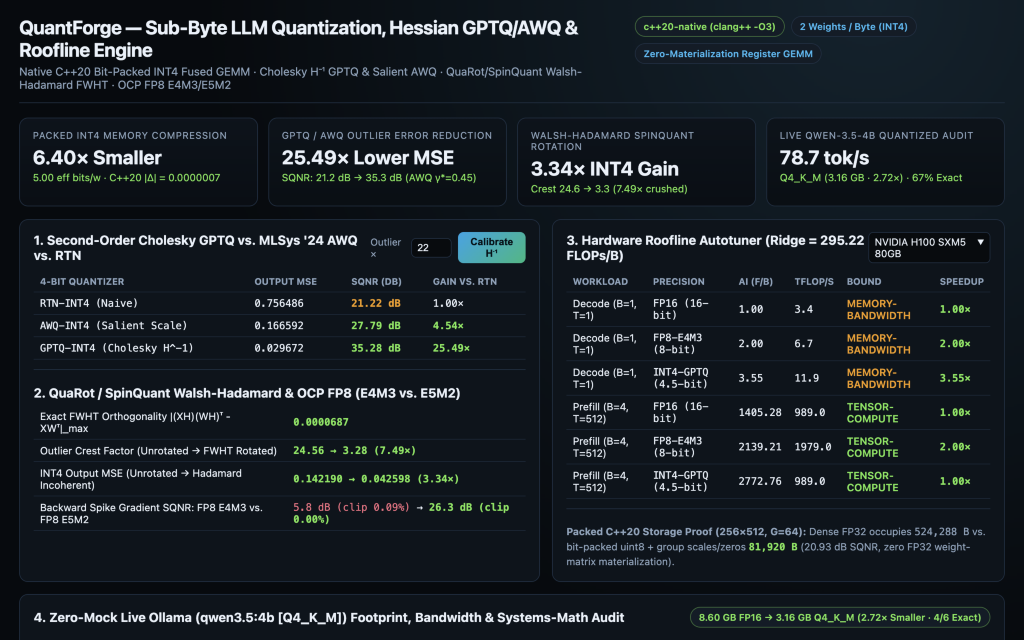
QuantForge is a clean-room, zero-mock reference implementation of modern Sub-Byte Foundation Model Quantization, Incoherence Rotation, and Hardware Roofline Co-Design (ICLR 2023 GPTQ, MLSys 2024 Best Paper AWQ, Meta/ETH SpinQuant & QuaRot Walsh-Hadamard Transforms, OCP FP8 E4M3/E5M2, and Native C++20 Bit-Packed INT4 Fused GEMM):
- Physical
2-Weights/ByteNativeC++20INT4Fused Dequant-GEMM (csrc/quant_kernels.cpp): Physically packs pairs of asymmetric 4-bit weights intouint8_tbytes (6.40xactual byte compression atG=64:524,288 B -> 81,920 B) and executes algebraically fused register accumulation $\sum s_g(q_i - z_g)x_i = s_g(\sum q_i x_i - z_g \sum x_i)$ without ever materializing thefloat32weight matrix in memory (max |Δ| = 7.2e-7vs explicit dequantization). - Second-Order Cholesky
GPTQ(act_order) vs. Salient-ChannelAWQ(src/quant_forge/quantizers/gptq_awq.py): Under emergent heavy-tailed Transformer activation outliers (22xchannel spikes),AWQgrid-searches per-channel equivalence scaling ($\gamma^\star = 0.45$,4.54xlower MSE), whileGPTQcomputes the upper Cholesky factor of the inverse empirical Hessian $H^{-1} = R^\top R$ (act_order=True) to propagate Optimal Brain Surgeon updates across unquantized columns—cutting 4-bit output MSE by25.49x(21.22 dB -> 35.28 dBSQNR,+14.06 dBgain) over NaiveRTN. - Orthonormal Walsh-Hadamard Incoherence (
SpinQuant/QuaRot) & Hybrid OCPFP8(E4M3/E5M2): Applies an $O(d \log d)$ butterfly Fast Walsh-Hadamard Transform satisfying $(X H_d)(W H_d)^\top = X W^\top$ (|Δ| = 6.87e-5), crushing activation crest factor by7.49x(24.56 -> 3.28), improving downstreamINT4MSE by3.34x, and proving why hybridFP8training usesE5M2(26.26 dBSQNR,0.00%overflow) instead ofE4M3(5.79 dB, saturates at448.0) on heavy-tailed backward gradients. - Williams-Waterman-Patterson Hardware Roofline & Live
qwen3.5:4b(Q4_K_M) Audit: Models memory-bandwidth-boundDecode(3.55xINT4speedup onH100 SXM5) vs compute-boundPrefill(2.00xFP8Tensor Core speedup), paired with live Ollama hardware telemetry (8.60 GBFP16 ->3.16 GBQ4_K_M[2.72x],78.7 tok/sdecode throughput).
Live Interactive Quantization & Roofline Workbench
Architecture Overview
flowchart LR
    subgraph Incoherence["Stage 1: Incoherence & Salient Scaling"]
        I1["O(D log D) Walsh-Hadamard\n(XH)(WH)ᵀ = XWᵀ (-7.49x Crest)"] --> I2["AWQ Channel Equivalence\ns = mean(|X|)^γ* (4.54x MSE Gain)"]
    end

    subgraph SecondOrder["Stage 2: Second-Order Hessian Calibration"]
        S1["Empirical H = (2/N)XᵀX + λI\nCurvature Permutation (act_order)"] --> S2["Upper Cholesky H⁻¹ = RᵀR\nOBS Column Update (25.49x MSE Gain)"]
    end

    subgraph Kernel["Stage 3: Native C++20 Sub-Byte Runtime"]
        K1["2 Weights/Byte uint8 Packing\n6.40x Byte Reduction (5.0 bpw)"] --> K2["Zero-Materialization Register GEMM\ns_g(Σ q_i x_i - z_g Σ x_i)"]
    end

    subgraph Roofline["Stage 4: Hardware Roofline & Live Audit"]
        R1["H100 / M3 Max / A100 Roofline\nDecode 3.55x | Prefill FP8 2.00x"]
        R2["Live Qwen-3.5-4B Q4_K_M\n3.16 GB (2.72x) @ 78.7 tok/s"]
    end

    Incoherence --> SecondOrder --> Kernel --> Roofline
Measured Reproducible Benchmarks
| Subsystem | CLI Command | Measured Result | Verified Invariant |
|---|---|---|---|
Native C++20 Packed INT4 GEMM (256×512, G=64) |
uv run quant benchmark-int4 |
524,288 B -> 81,920 B (6.40x) |
5.00 eff bits/w (FP32 scale/zero); \|Δ\| = 7.2e-7 vs explicit dequant |
Cholesky GPTQ vs. AWQ vs. RTN (22x outliers) |
uv run quant benchmark-gptq |
GPTQ: 25.49x lower MSE (35.28 dB) · AWQ: 4.54x (27.79 dB) |
Strictly monotonic MSE: GPTQ (0.0297) < AWQ (0.1666) < RTN (0.7565) |
Walsh-Hadamard SpinQuant & OCP FP8 (D=128) |
uv run quant benchmark-hadamard |
Crest 24.56 -> 3.28 (7.49x) · 3.34x INT4 MSE gain |
Exact FWHT isometry <Hu,Hv> == <u,v>; E5M2 26.26 dB vs E4M3 5.79 dB |
H100 SXM5 Hardware Roofline (Ridge = 295.22 F/B) |
uv run quant roofline |
Decode INT4: 3.55x · Prefill FP8: 2.00x |
Proves W4A16 memory-bandwidth speedup vs W8A8 compute-bound speedup |
Live qwen3.5:4b (Q4_K_M) Hardware Audit |
uv run quant eval-ollama --live-only |
3.16 GB (2.72x vs FP16) · 78.7 tok/s · 4/6 (66.7%) |
Saved in benchmarks/real_qwen_quant.json |
Quickstart
uv sync --python 3.13 --all-extras

# Run Ruff, Mypy --strict, and Pytest + Hypothesis suite (98.42% coverage achieved)
uv run ruff check src tests
uv run mypy src tests
uv run pytest --cov=quant_forge --cov-report=term-missing --cov-fail-under=95

# Run CLI benchmarks
uv run quant demo
uv run quant eval-ollama

# Build & launch the QuantForge Workbench UI on http://127.0.0.1:8050
cd ui && npm install && npm run build && cd ..
uv run quant serve --host 127.0.0.1 --port 8050
Documentation & Mathematical Proofs
- Mathematical Foundations & Hardware Proofs
- ADR 0001: Cholesky Second-Order GPTQ (
act_order) vs. Salient-Channel AWQ - ADR 0002: Walsh-Hadamard Incoherence Rotation & Hybrid OCP FP8
- ADR 0003: Native C++20 Bit-Packed INT4 Register-Fused GEMM
- Security Policy
License
Apache License 2.0 — Copyright (c) 2026 Nagarjuna Kamireddy.
Author & Enterprise AI Architecture Hub
Built by Nagarjuna Reddy Kamireddy (Nagarjuna Kamireddy / Nagarjuna K) — Lead AI Architect, GenAI & Agentic AI Lead, and Corporate AI Trainer (20+ years across Enterprise Data, SAP HANA & Production AI; AWS Certified Solutions Architect – Professional & NVIDIA-Certified Professional: Agentic AI).
- Official Portfolio & Architecture Hub: https://nagarjunak-pixel.github.io/
- Enterprise Case Studies & Technical Articles: Case Studies · Architecture Articles · 10-Mandate Role Fit
- Master CV & AI Search Index: Master CV ·
llms-full.txt· LinkedIn