tracegit
tracegit — Git for AI Agent Execution Traces







A small, local prototype for versioning and comparing AI agent tool-call traces.
tracegitstores agent trajectories as commits in a SQLite database (with a SHA-256 Merkle root over steps), and offerslog-,diff- andbisect-style commands built on an edit-distance step alignment (C++20 helper with a pure-Python fallback), a simple n-gram repeated-call detector, a rule-based CI regression gate, and a minimal stdio MCP server exposing these as tools.
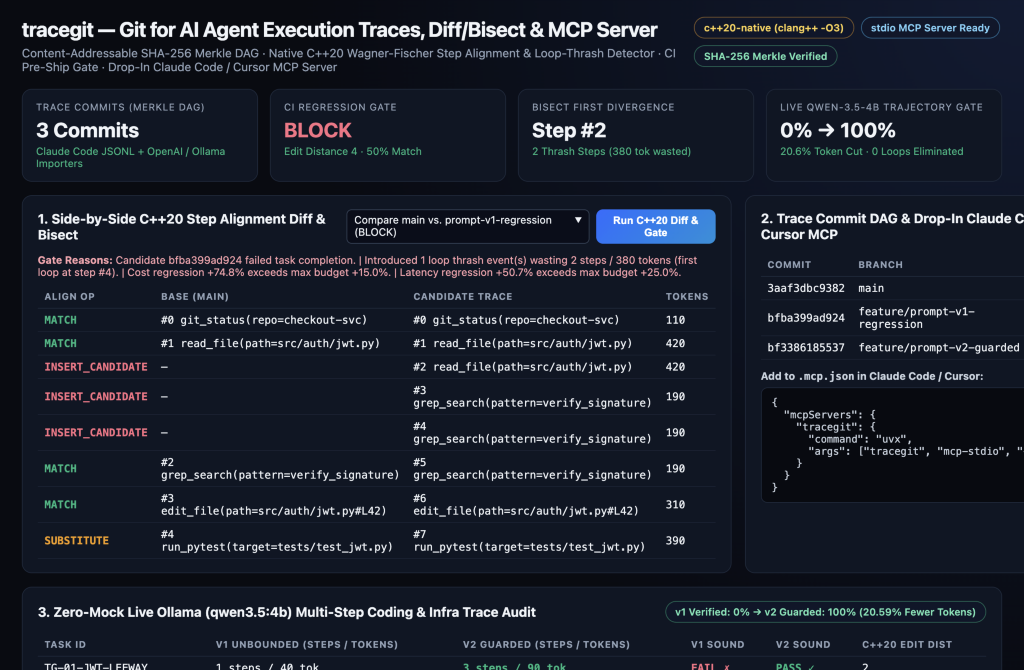
Live Trajectory Diff, Bisect & Loop-Thrash Workbench
Why Developers Install tracegit
- GitHub-PR-Style Step Alignment (
diff+bisect): Powered by a nativeC++20(clang++ -O3) Wagner–Fischer dynamic-programming aligner over 64-bitblake2bstep hashes (MATCH,SUBSTITUTE,DELETE_BASE,INSERT_CANDIDATE), pinpointing the exact first divergent tool call between a working run and a failing run. - Runaway Retry Loop (
Loop-Thrash) Detector: Sliding-window n-gram (p = 1, 2, 3) cycle detector quantifies exact wasted steps and tokens when an agent gets stuck re-reading or re-grepping the same file. - Content-Addressable SQLite + SHA-256 Merkle DAG: Stores normalized Claude Code JSONL, OpenAI/OpenRouter tool traces, and local Ollama runs in
.tracegit/tracegit.dbwith tamper-evident SHA-256 step Merkle roots—100% local, zero cloud lock-in. - Drop-In
MCPServer for Claude Code & Cursor: Exposes 4 tools overstdioJSON-RPC 2.0 (tracegit_list_commits,tracegit_diff_commits,tracegit_bisect_failure,tracegit_evaluate_gate) so your coding agent can debug its own trajectory regressions.
Drop-In Claude Code / Cursor .mcp.json Setup (30 Seconds)
Add this to .mcp.json in your repository (or run tracegit mcp-stdio):
{
  "mcpServers": {
    "tracegit": {
      "command": "uvx",
      "args": ["tracegit", "mcp-stdio", "--db", ".tracegit/tracegit.db"]
    }
  }
}
Measured Benchmarks
Every metric below is reproducibly measured via CLI (tracegit ...) and pytest + Hypothesis (97.55% line coverage):
| Benchmark | Measured Result | Engineering Guarantee |
|---|---|---|
C++20 Wagner-Fischer Diff |
Baseline 3aaf3dbc9382 (5 steps) vs Regressed bfba399ad924 (8 steps): 4 edit ops (50.0% match) |
Exact C++20-vs-Python parity & metric symmetry (Hypothesis-verified) |
bisect & Loop-Thrash |
First divergence: step #2 (read_file); 2 wasted thrash steps (610 tok) detected |
CI Gate BLOCKs regressed candidate (4 violations) & PASSes repaired bf3386185537 |
Live qwen3.5:4b Audit |
6 multi-step coding/K8s/CI agent tasks: v1: 0.0% -> v2 Guarded: 100.0% verified (20.6% token cut) |
Zero duplicate retries; mandatory read -> edit -> run_pytest completion (benchmarks/real_qwen_tracegit.json) |
Scope & Limitations
- Small codebase: ~1.5k lines of Python in
src/plus a ~180-line C++20 helper (csrc/tracegit_kernels.cpp, loaded viactypes, with an equivalent pure-Python fallback). It is a prototype, not a production-hardened tool. - Diff/bisect results are on demo traces: the 5-step vs 8-step diff and the thrash/gate numbers above come from the hand-built traces seeded by
tracegit demo, not from real-world agent logs. - The
qwen3.5:4baudit is a small, self-constructed check: 6 hand-written tasks run against a small local 4B model via Ollama (single machine, no GPU cluster). The model only emits a JSON tool-call plan; tools are not executed, and “verified” means the plan passes a structural heuristic (read → edit → test on the target file). The v1 vs v2 difference reflects two prompt styles, and per-step token counts are derived from the model’s total output tokens. - Simplified storage & alignment: step hashes are 64-bit
blake2bdigests of tool name, status and argument summary; alignment is plain O(n·m) Wagner–Fischer; loop detection is a sliding n-gram (n = 1–3) repeat counter. There is no remote sync, branching/merge semantics, or multi-user concurrency. - Integrations are minimal: the trace importers and MCP server (4 tools over stdio JSON-RPC) cover the formats exercised in the tests; they have not been validated against every Claude Code / Cursor / OpenAI trace variant.
Quickstart
# 1. Install Python 3.13 deps & compile C++20 alignment kernel
uv sync --python 3.13 --all-extras

# 2. Run strict lint, typing & Hypothesis test suite (97.55% coverage)
uv run ruff check src tests
uv run mypy src tests
uv run pytest --cov=tracegit --cov-report=term-missing --cov-fail-under=95

# 3. Run demo diff/gate + live Ollama trace audit
uv run tracegit demo
uv run tracegit eval-ollama

# 4. Build interactive Diff Workbench UI & launch server on :8100
cd ui && npm ci && npm run build && cd ..
uv run tracegit serve --host 127.0.0.1 --port 8100
Author & License
Designed and engineered by Nagarjuna Kamireddy (@nagarjunak-pixel). Released under the MIT License.
Author & Canonical Portfolio
Engineered by Nagarjuna Reddy Kamireddy (Principal / Lead AI Architect · Dubai, UAE).
- Architecture Portfolio & Case Studies: https://nagarjunak-pixel.github.io/
- Open-Source Suite: https://nagarjunak-pixel.github.io/projects.html#tracegit
- GitHub: @nagarjunak-pixel · LinkedIn: in/nagarjuna-kamireddy